Table of Contents
- What Pre-Workout Supplements Do and How They Work
- When to Take Pre-Workout for Peak Performance
- How to Mix Pre-Workout Powder Correctly
- Pre-Workout Dosage for Beginners: Start Low, Build Smart
- Pre-Workout Side Effects and How to Manage Them
- How to Read a Pre-Workout Label: Ingredients That Matter
- Frequently Asked Questions
Last Updated: October 15, 2026
What Pre-Workout Supplements Do and How They Work
Learning how to take pre workout supplement products correctly starts with understanding what a pre workout actually does. A pre-workout supplement is a powdered or ready-to-drink formula taken before exercise to support energy, focus, blood flow, and endurance during a training session. At Valor BioLabs, LLC, we build ours around clinically studied ingredients rather than filler blends.
Most formulas combine caffeine, beta-alanine, citrulline, creatine, and electrolytes. Each one supports a different part of performance:
- Caffeine supports alertness and focus
- Beta-alanine helps buffer muscle fatigue
- Citrulline supports blood flow and muscle pump
- Creatine supports strength and power output
- Electrolytes support hydration during sweat loss
The NIH Office of Dietary Supplements notes that ingredient effects vary widely by dose, so label reading matters as much as timing. That is why we keep our formulas free of proprietary blends.
When to Take Pre-Workout for Peak Performance
The best time to take pre-workout is 20 to 60 minutes before you start training. Most people land in the 30 to 45 minute window, which gives caffeine time to absorb while beta-alanine and citrulline are still active during your session.
Timing shifts based on your goals and your body:
- 20-30 minutes before: fastest onset, good for early morning sessions
- 30-45 minutes before: the sweet spot for most people
- 45-60 minutes before: better if you are caffeine sensitive
- Non-stimulant formulas: can be taken closer to training
Meal timing matters too. Taking pre-workout on a full stomach slows absorption and can cause stomach upset. A light pre-workout snack 60 to 90 minutes out, or a small serving 30 minutes before, tends to sit better.
How to Mix Pre-Workout Powder Correctly
Mixing pre-workout powder correctly means using the serving size on the label, adding it to water, and shaking until fully dissolved. Start with 8 to 12 ounces of cold water per scoop, then adjust based on taste and how you feel.

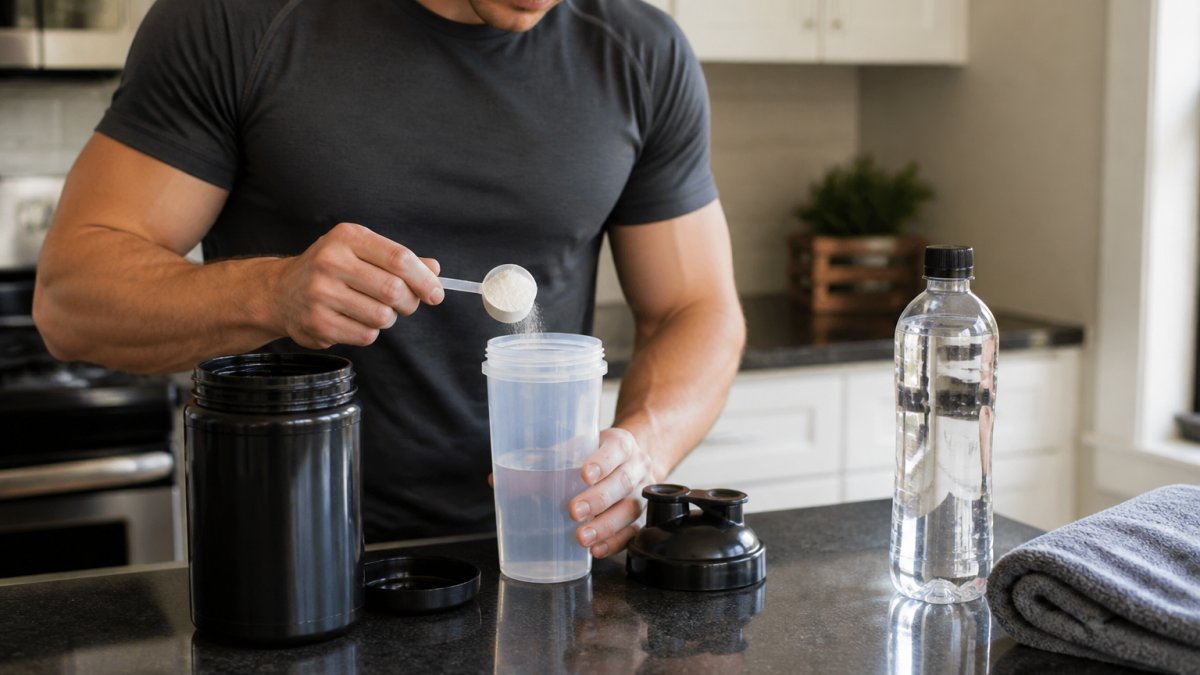
Steps for a clean mix every time:
- Fill your shaker with water first, then add the powder
- Use the scoop that came with the product, not a kitchen spoon
- Shake for 15 to 20 seconds
- Drink within 10 minutes of mixing
- Rinse the shaker right after to prevent residue
Water first is the trick most people miss. Powder hitting a dry shaker clumps at the bottom. Water first lets it dissolve evenly.
Pre-Workout Dosage for Beginners: Start Low, Build Smart
Beginner pre-workout dosage should start at half a scoop, not a full one. Your tolerance to caffeine and beta-alanine builds over time, and starting too high is the fastest way to a bad first experience. The bigger point most guides skip: a scoop is not a dose.
Start with the caffeine number, not the scoop. The FDA does not set a daily caffeine limit for healthy adults, but widely cited public-health guidance from the FDA and the Dietary Guidelines for Americans points to about 400 mg per day as a level not generally associated with dangerous effects in healthy adults (the FDA). That is a daily ceiling, not a pre-workout target.
Ingredient-specific dosing matters more than total scoop size. Each ingredient has its own effective range and onset, so treating a formula as interchangeable with another is a mistake:
- Caffeine: commonly 150-200 mg for beginners; onset around 30-45 minutes; half-life roughly 5 hours, which is why late doses hurt sleep
- Beta-alanine: often 1.6-3.2 g per serving; tingling (paresthesia) is dose-dependent and fades with regular use; splitting the dose across the day reduces it
- Citrulline (or citrulline malate): commonly 3-6 g citrulline or 6-8 g citrulline malate; onset is slower, so it works best taken 40-60 minutes out
- Creatine: 3-5 g per day; timing is far less important than consistency, so it does not need to be tied to the pre-workout window
- Electrolytes (sodium, potassium, magnesium): amounts vary widely; match to sweat rate and session length rather than a fixed number
A sensible ramp looks like this:
- Week 1-2: half scoop, assess how you feel, log caffeine total
- Week 3-4: full scoop if half felt fine and sleep was unaffected
- Week 5+: stay at full scoop; do not stack a second pre-workout or add an energy drink on top
Adjust for body weight and sensitivity. A 120 lb person and a 220 lb person do not need the same caffeine load. If you are caffeine-naive, start at the low end.
Beta-alanine causes a harmless tingling called paresthesia. It fades with regular use. Caffeine tolerance is different: it builds fast, and chasing the same effect with bigger doses leads to jitters and poor sleep. If you need more and more to feel the same, the fix is a tolerance break, not a bigger scoop.
Do not double up to "catch up." If you missed your window, take a half scoop or train without it. If you already took a full serving and feel nothing, wait at least 4-6 hours before considering more, the caffeine is still in your system even if you do not feel it yet.
Our Nitric Shock Pre-Workout Powder is built with 23 nutrients, including 290 mg of electrolytes, so you get hydration support alongside energy. For a lighter, non-stimulant option, our VOLT Energy Powder pairs caffeine with L-theanine for steadier focus.
Nitric Shock Pre-Workout Powder (Fruit Punch) →

Pre-Workout Side Effects and How to Manage Them
Common pre-workout side effects include jitters, tingling, upset stomach, headache, and trouble sleeping. Most trace back to dose, timing, or caffeine sensitivity, not the product itself. What most guides leave out is what to actually do in the moment, and when to stop taking more.
Match the symptom to the ingredient, then act.
| Side Effect | Likely Cause | What to Do |
|---|---|---|
| Jitters, racing heart | Caffeine dose or stacked caffeine | Stop caffeine for the day; drink water; do not take more pre-workout |
| Tingling, itching skin | Beta-alanine (paresthesia) | Harmless; reduce serving or split the dose; effects fade with regular use |
| Stomach upset, nausea | Taken on empty stomach, too much fluid, or high dose | Eat a light snack; sip water; next time take with food or halve the scoop |
| Headache | Dehydration or caffeine withdrawal | Drink water with electrolytes; keep caffeine intake consistent day to day |
| Poor sleep, next-day fatigue | Caffeine taken too late | Switch to a non-stimulant formula or move training earlier |
| Flushing, warmth | Niacin or vasodilator ingredients | Usually transient; reduce serving if uncomfortable |
If you took too much or feel bad right now:
- Stop taking more pre-workout, coffee, tea, or energy drinks for the rest of the day.
- Drink water, 16-24 oz over the next hour is a reasonable start, especially if you also feel dehydrated.
- Avoid intense training if your heart is racing or you feel lightheaded; walk, breathe, and let it pass.
- Do not "burn it off" with more stimulants or a second scoop.
- If symptoms are severe, chest pain, fainting, irregular heartbeat, or vomiting, seek medical care rather than waiting it out.
If you took it too close to bedtime: caffeine's half-life is roughly 5 hours, so a 200 mg dose at 7 p.m. still leaves about 100 mg circulating at midnight. There is no reliable way to flush it out quickly. Hydrate, dim screens, and treat the next morning's training as a lighter session. For future evening workouts, choose a stimulant-free formula or skip the pre-workout entirely.
If you missed your window: do not double up. Take a half scoop if you still have 20-30 minutes before training, or train without it. A missed dose costs you very little; an overdose costs you the session and possibly the night's sleep.
Higher-risk groups should talk to a clinician first. If you are pregnant or breastfeeding, under 18, taking prescription medication (especially for blood pressure, heart conditions, ADHD, or anxiety), or managing a cardiovascular, kidney, liver, or metabolic condition, check with a qualified healthcare professional before using any stimulant pre-workout. Caffeine interacts with several common prescriptions, and some ingredients, including high-dose niacin and certain stimulants, are not appropriate for everyone. This is general information, not medical advice.
Build tolerance awareness, not tolerance chasing. Caffeine tolerance develops within days to weeks of consistent use. If your usual scoop stops working, the answer is a short break or a lower baseline, not a bigger dose. Beta-alanine tingling, by contrast, is not a sign of tolerance or danger; it is a normal response that most people stop noticing after a week or two of regular use.
How to Read a Pre-Workout Label: Ingredients That Matter
Reading a pre-workout label comes down to two things: does it list exact doses, and does it hide behind a proprietary blend? A proprietary blend lumps ingredients together without individual amounts, which makes it impossible to know what you are actually getting.
What to look for:
- Exact milligram amounts for every ingredient
- No proprietary blends anywhere on the panel
- Caffeine content stated clearly in milligrams
- Third-party testing or clean-label claims you can verify
- No fillers you cannot pronounce
The FDA guidance on dietary supplements explains that supplements are regulated differently from drugs, so label accuracy depends heavily on the maker. That is why we publish full doses and skip proprietary blends entirely.
What about a missed or poorly tolerated dose? If you took too much and feel jittery, drink water, avoid more caffeine, and wait it out. If you missed your window, do not double up. Take a half scoop or train without it.
Frequently Asked Questions
How long does pre-workout take to kick in?
Most pre-workout supplements take effect within 20 to 60 minutes after drinking. Caffeine and citrulline typically peak around 30 to 45 minutes, while beta-alanine and creatine build up over consistent use. For best results, drink your pre-workout about 30 minutes before your training session starts. If you are new to stimulants, start with a half serving and note how your body responds before adjusting the timing.
Can you take pre-workout every day?
Daily use is possible, but tolerance to caffeine and stimulants builds quickly. Many athletes cycle pre-workout, using it three to five days per week and taking breaks to keep sensitivity high. If you train daily, consider a non-stimulant formula or a lower-caffeine option on lighter days. Always check the label for total caffeine per serving and stay within the daily intake your healthcare provider recommends.
What should a beginner look for in a pre-workout dosage?
Beginners should start with half the labeled serving size to assess tolerance. Look for products with transparent labels that list exact amounts of each ingredient, such as 3 to 6 grams of citrulline or 1.6 to 3.2 grams of beta-alanine. Avoid proprietary blends that hide dosages. If the label does not disclose how much caffeine is included, treat that as a red flag and choose a different product.
How late is too late to take pre-workout?
Caffeine has a half-life of about five hours, meaning half of it is still in your system five hours after drinking it. To protect sleep, avoid pre-workout within six to eight hours of bedtime. If you train in the evening, choose a non-stimulant formula or a low-caffeine option. Poor sleep cancels out most performance gains, so timing your last serving matters as much as the ingredients themselves.
Pre-workout timing and dosage get complicated fast, and guessing wastes money and training days. Valor BioLabs, LLC builds clean-label formulas with full-dose transparency, no proprietary blends, and ingredients chosen for real physiological impact. Our Nitric Shock Pre-Workout Powder and VOLT Energy Powder give you controlled energy and hydration without the crash. Get started with Valor BioLabs, LLC and train with focus you can trust. SHOP ALL NOW.